
Anxiety disorders are among the most common mental health conditions in contemporary societies. According to data from the World Health Organization, they represent one of the leading causes of reduced quality of life and work-related absenteeism. Despite growing public awareness, anxiety is still frequently underestimated and perceived as “oversensitivity” or temporary stress, which leads to delayed diagnosis and progressive symptom worsening.

It is important to emphasize that anxiety disorders are not a sign of psychological weakness. They result from complex interactions between biological, psychological, and environmental factors. This article presents a comprehensive overview of anxiety disorders—from definitions and symptoms to underlying mechanisms, treatment methods, the role of diet, and the importance of prevention.
Anxiety as an Adaptive Mechanism
In its primary form, anxiety serves an adaptive function. It is the body’s response to potential threat and activates the “fight or flight” mechanism. This response is accompanied by an increased heart rate, heightened muscle tension, and increased alertness.
The problem arises when this mechanism is activated in the absence of a real threat or persists for an extended period. In anxiety disorders, the nervous system loses the ability to regulate this response appropriately, and the body remains in a state of chronic arousal, leading to physical and psychological exhaustion.
Classification of Anxiety Disorders
Anxiety disorders encompass a broad spectrum of clinical entities that differ in symptom presentation and course, including:
Generalized Anxiety Disorder (GAD) – chronic anxiety and excessive worry about everyday matters.
Panic Disorder – recurrent panic attacks, often interpreted as life-threatening events.
Specific Phobias – intense fear of specific objects or situations.
Social Anxiety Disorder – fear of social evaluation and exposure.
Obsessive-Compulsive Disorder (OCD) – intrusive thoughts and compulsive behaviors.
Post-Traumatic Stress Disorder (PTSD) – long-term consequences of traumatic experiences.
Each of these conditions may lead to significant impairment in social and occupational functioning.
Symptoms of Anxiety Disorders
Anxiety symptoms are multidimensional and are often mistaken for somatic illnesses.
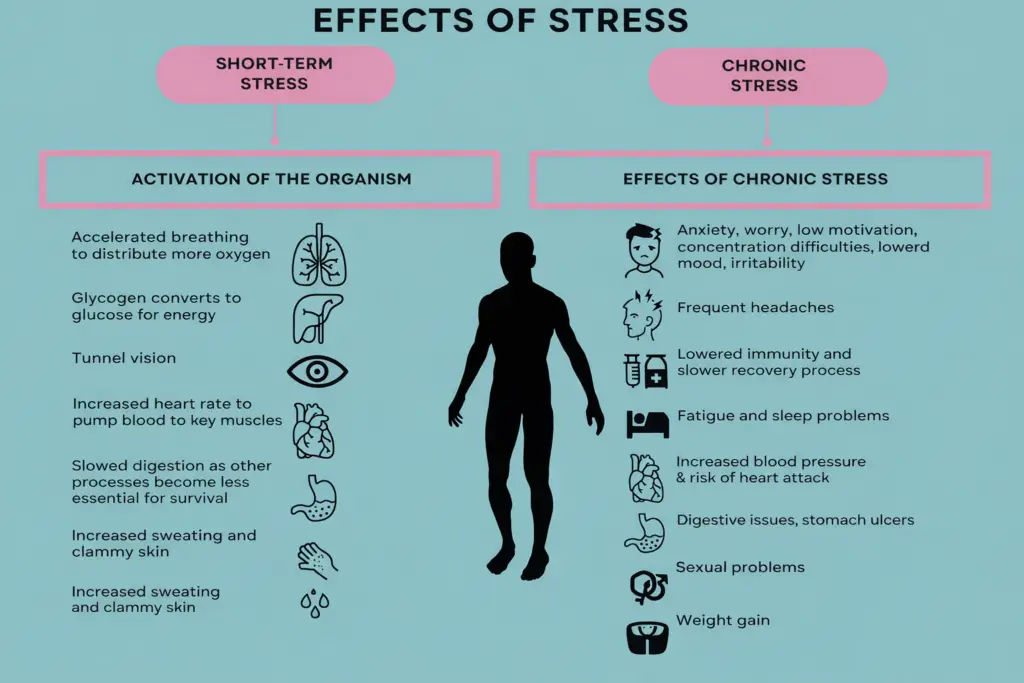
Psychological symptoms:
persistent sense of threat,
excessive worry,
difficulty concentrating,
intrusive catastrophic thoughts,
feelings of derealization or depersonalization,
fear of losing control or dying.
Somatic symptoms:
palpitations and increased heart rate,
shortness of breath and shallow breathing,
dizziness,
abdominal pain and nausea,
muscle tension,
trembling of the limbs,
excessive sweating,
hot and cold flashes,
insomnia.
These symptoms result from activation of the autonomic nervous system and the hypothalamic–pituitary–adrenal (HPA) axis.
Neurobiological Basis of Anxiety Disorders
Neurobiological research indicates that anxiety disorders are associated with:
hyperreactivity of the amygdala,
impaired regulation by the prefrontal cortex,
dysregulation of neurotransmitters (serotonin, GABA, norepinephrine),
chronically elevated cortisol levels.
Prolonged stress leads to structural and functional changes in the brain, reinforcing anxiety responses.
Psychological and Environmental Risk Factors
Factors that increase the risk of developing anxiety disorders include:
traumatic childhood experiences,
chronic occupational stress,
lack of social support,
perfectionism,
excessive need for control and predictability,
fast-paced lifestyle and pressure to succeed.
Anxiety disorders often develop gradually, without a single clearly identifiable onset.
Treatment of Anxiety Disorders – A Comprehensive Approach
Psychotherapy
Psychotherapy is the cornerstone of treatment. Cognitive-behavioral therapy (CBT) helps patients to:
identify anxiety mechanisms,
modify maladaptive interpretations of symptoms,
habituate to physiological responses,
gradually confront feared situations.
Psychoeducation also plays a crucial role by reducing fear of the symptoms themselves.
Pharmacotherapy
Pharmacological treatment may be necessary in more severe cases. Commonly used medications include:
antidepressants,
anxiolytics.
The goal of pharmacotherapy is to restore neurochemical balance rather than to “suppress emotions.”
The Role of Lifestyle in Anxiety Regulation
Lifestyle factors have a profound impact on nervous system functioning. Particularly important are:
regular sleep patterns,
physical activity,
reduction of stressors,
learning relaxation techniques,
developing the ability to rest and recover.
Even small, gradual changes can significantly reduce anxiety levels.
Diet and Anxiety Disorders
An increasing body of research highlights the role of the gut–brain axis in emotional regulation. Disruptions in gut microbiota may exacerbate anxiety symptoms.
Foods that may increase anxiety:
simple sugars,
caffeine,
alcohol,
highly processed foods.
Foods that support the nervous system:
omega-3-rich fish,
leafy green vegetables,
fermented foods,
whole grains,
nuts and seeds,
magnesium and B vitamins.
Prevention and the Importance of Early Diagnosis
Prevention of anxiety disorders includes:
emotional education,
development of stress management skills,
maintaining social relationships,
achieving balance between work and personal life.
Early diagnosis helps prevent chronicity and secondary consequences such as depression or substance use disorders.
Anxiety Disorders and Social Functioning
Untreated anxiety may lead to:
social isolation,
occupational difficulties,
reduced self-esteem,
problems in interpersonal relationships.
References
American Psychiatric Association. (2022). DSM-5-TR: Diagnostic and Statistical Manual of Mental Disorders.
Bandelow, B., Michaelis, S. (2015). Epidemiology of anxiety disorders in the 21st century.
Baldwin, D. S. et al. (2014). How long should patients with anxiety disorders continue treatment?
Cryan, J. F., Dinan, T. G. (2012). Mind-altering microorganisms.
Hofmann, S. G. et al. (2012). The efficacy of cognitive behavioral therapy.
Jacka, F. N. et al. (2017). Dietary improvement and mental health.
World Health Organization. (2017). Depression and Other Common Mental Disorders.
Sarris, J. et al. (2015). Nutritional medicine in psychiatry.