
Does screen use really harm a child’s brain, or is it just modern parental panic?
In a world full of smartphones, tablets, and televisions, it’s hard to find a clear-cut answer. Science, however, points to something important: the issue isn’t as simple as it seems—it’s not just about the screen itself, but about how it affects developing neural connections. In the first years of life, the brain is especially sensitive to stimuli, which means the way technology is used may matter far more than most of us realize.
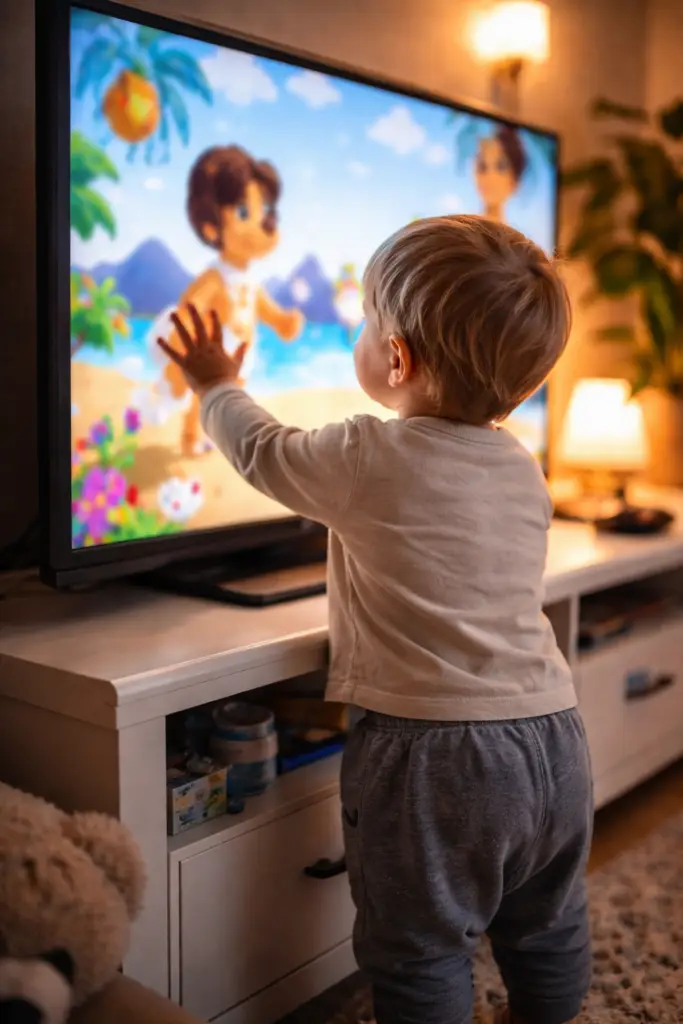
Child brain development is one of the most dynamic and sensitive biological processes in the entire human lifespan. In the first years of life, the number of synaptic connections reaches its peak—far exceeding what is observed in adults. This stage is known as synaptic overproduction, followed by a phase of selection called synaptic pruning. The brain retains connections that are used and eliminates those that are unnecessary. In other words, brain development is strongly experience-dependent.
In this context, a fundamental question arises: what kind of experiences does screen exposure provide for a child, and how do they influence brain organization?
From a neurobiological perspective, the most important stimuli for development are social and sensorimotor experiences. Eye contact, facial expressions, tone of voice, and emotional responses all activate complex neural networks, including the prefrontal cortex, the limbic system, and language-processing areas. These interactions are dynamic, bidirectional, and tailored to the child.
Screens function differently. They provide stimuli, but typically in a one-sided way, lacking real interaction. The child sees and hears, but does not participate in a true dialogue. This is a crucial difference from the standpoint of brain development.
However, this does not mean that all screen exposure is harmful. Neuroimaging studies show that children who use high-quality educational content in moderation do not exhibit clear negative structural changes. The problem arises with excessive exposure and certain types of content.
One of the best-documented effects concerns language development. Brain regions responsible for speech processing—such as Broca’s and Wernicke’s areas—develop in response to active communication. A child needs not only to hear words, but also to respond, ask questions, and receive answers. Passive viewing does not engage these mechanisms to the same extent as interaction with a caregiver.
Research indicates that greater screen time in young children correlates with lower levels of language development. This mechanism does not result from any “toxic” effect of screens, but rather from a reduction in the number of language interactions.
Another important aspect is the reward system and dopamine. Modern digital content, especially short and fast-paced videos, delivers rapid and intense stimulation. This leads to frequent activation of the reward system, which relies on neurotransmitters such as dopamine. In a developing brain, this may promote a preference for immediate gratification and difficulties maintaining attention in less stimulating situations.
This is not “addiction” in the classical sense, but rather an adaptation of the brain to a specific type of stimulus. A child accustomed to rapid changes in images may struggle to focus on tasks that require patience, such as reading or learning.
Equally important is the impact of screens on the development of executive functions, which are associated with the prefrontal cortex. These include planning ability, impulse control, cognitive flexibility, and emotional regulation. These functions develop gradually and require experiences that actively engage the child—such as play, problem-solving, and social interaction.
Excessive screen time may limit these experiences, indirectly affecting the development of these functions. Again, the issue is not the screen itself, but what it replaces.
The impact on sleep should not be overlooked, as sleep is crucial for brain maturation. During sleep, processes such as memory consolidation and synaptic regulation occur. Exposure to blue light emitted by screens suppresses melatonin production and may disrupt these processes. Long-term sleep disturbances during development can have real effects on cognitive and emotional functioning.
It is also worth noting neuroimaging findings suggesting that children with very high screen time may show differences in white matter integrity—structures responsible for communication between different brain regions. However, these findings must be interpreted cautiously—it is unclear whether this is a causal effect or merely a correlation linked to other environmental factors.
One of the most important and well-documented mechanisms is the so-called displacement effect. Time spent in front of screens replaces other activities—movement, play, and social interaction. These activities are essential for brain development. From a neurobiological perspective, the brain develops through action—not passive stimulation.
Contrary to popular claims, there is no evidence that screens cause autism. This is a myth not supported by scientific research. Autism spectrum disorders have complex genetic and neurodevelopmental origins.
Recommendations from organizations such as the American Academy of Pediatrics and the World Health Organization emphasize limiting screen time in young children and encouraging active parental involvement in media use. The key is not only “how much,” but above all “how.”
From a neurobiological perspective, the most beneficial factors for a child’s brain development are: direct social interactions, free play, physical activity, and multisensory experiences. Screens can be a supplement, but should not be the primary source of stimulation.
In summary, the impact of screens on a child’s brain development is not straightforward. They are not “neurotoxic,” but they can shape the developing brain indirectly—by altering patterns of activity, attention, and experience. The greatest risk is not the technology itself, but its overuse and the context in which it is used.
Patient FAQ
Does background TV (even when a child isn’t actively watching) matter?
Yes. Research shows that so-called “background TV” can reduce the quality of parent–child interactions and affect concentration.
Is giving a phone to calm a crying child a mistake?
Occasionally—no. Regularly—it may hinder the development of emotional regulation skills.
Will children raised “on screens” differ from previous generations?
Possibly—especially in attention, emotional regulation, and information processing.
Are there children who should not have any screen exposure at all?
Yes—particularly very young children (under 2 years old), when brain development is most sensitive.
Is the biggest problem not the screen… but us, the adults?
Often yes—the way we use technology around children has a major impact on their development.
Bibliography
American Academy of Pediatrics. Media and Young Minds. Pediatrics, 2016/2020
World Health Organization. Guidelines on physical activity, sedentary behaviour and sleep, 2019
Madigan S. et al. Association Between Screen Time and Children’s Performance. JAMA Pediatrics, 2019
Hutton J.S. et al. Associations Between Screen-Based Media Use and Brain White Matter Integrity. JAMA Pediatrics, 2020
Christakis D.A. The Challenges of Defining and Studying “Digital Addiction”. Pediatrics, 2019
Przybylski A.K., Weinstein N. A Large-Scale Test of the Goldilocks Hypothesis. Psychological Science, 2017
Canadian Paediatric Society. Screen time and young children, 2017
American Psychiatric Association. DSM-5